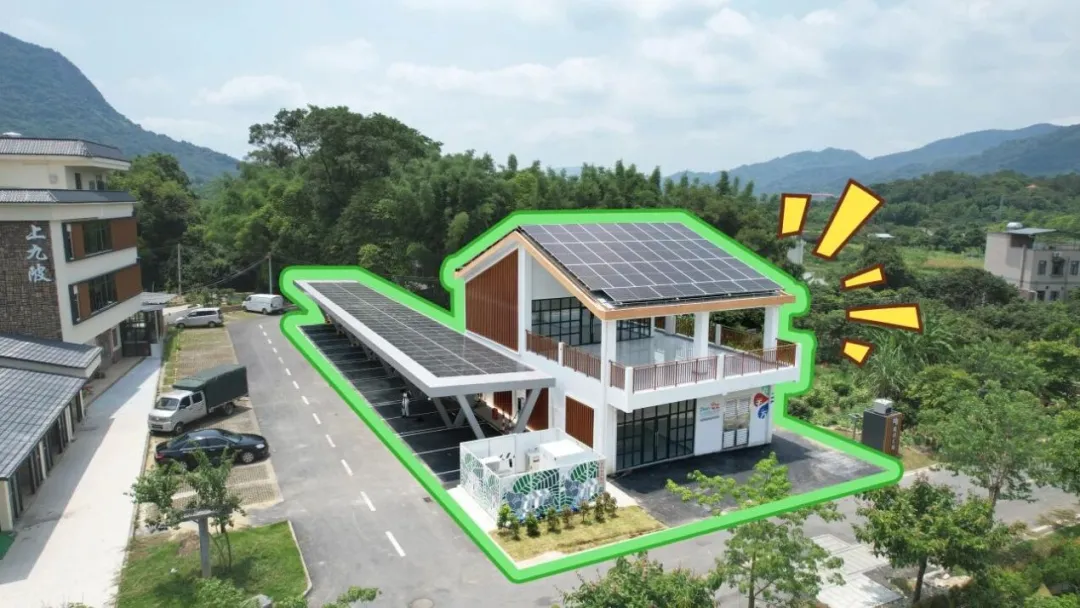
With the large-scale integration of distributed photovoltaics (PV) into distribution networks, achieving observability, measurability, controllability, and adjustability (collectively referred to as the "Four Controllabilities") for low-voltage PV systems, along with fast-response regulation, has become a critical bottleneck in the development of new power systems. Recently, Guangzhou Power Supply Bureau has promoted a "one gateway per substation area" model in Huadu, Zengcheng, and other districts, installing "smart valves" on low-voltage PV systems. Coupled with a master station system, this enables large-scale application of second-level flexible regulation for distributed PV, effectively addressing operational challenges caused by high-penetration PV integration. The core equipment in this scenario—the New Energy Four-Controllability Gateway—has been jointly developed by Dongfang Electronics and Guangzhou Power Supply Bureau, providing key technological support for the construction of Guangzhou's new power system and the efficient integration of new energy.
I. Transforming Dispersed Distributed Resources into Controllable Entities to Clear Bottlenecks in Green Power Grid Integration
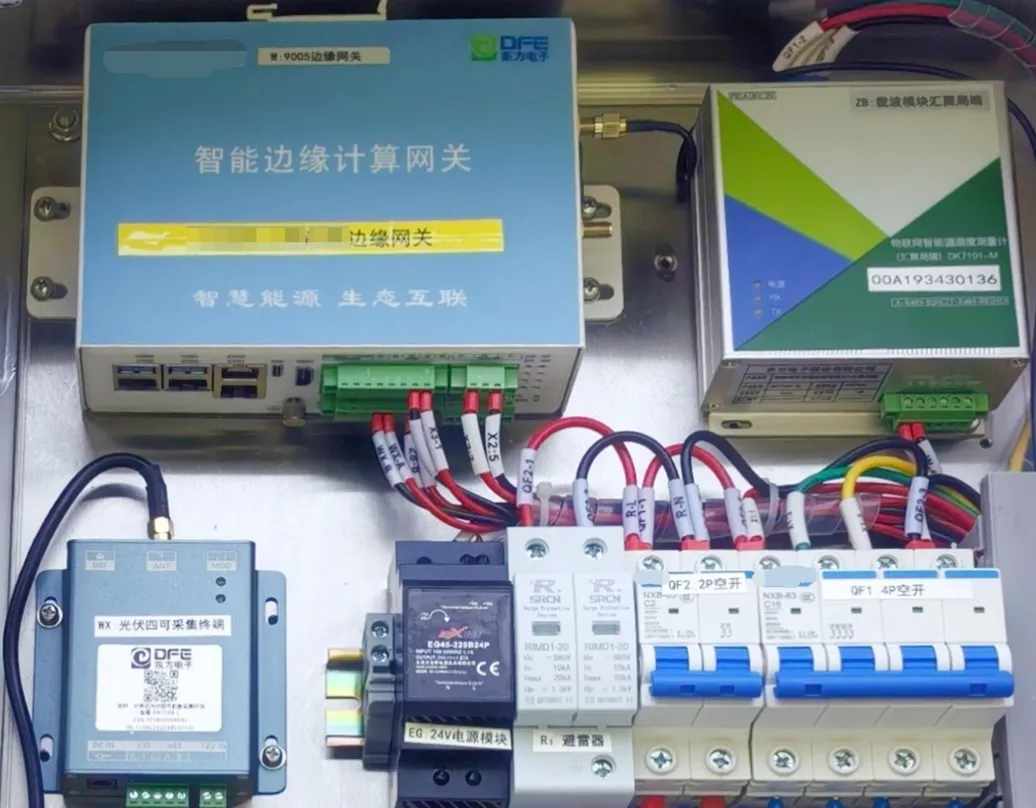
With the proliferation of distributed PV, the challenge of managing "fragmented" integration has become increasingly prominent. Dongfang Electronics' New Energy Four-Controllability Gateway (hereinafter referred to as "the Gateway") precisely addresses these bottlenecks in green power utilization, with core applications focused on grid safety, operational efficiency, and revenue enhancement. In terms of data monitoring, the Gateway collects real-time PV data from substation areas, making dispersed green power data measurable and quantifiable, thus ending the era of "black box" management. Regarding regulation execution, it can receive dispatch instructions within seconds to precisely adjust PV output, ensuring grid safety while prioritizing self-consumption for users, achieving a win-win outcome. Furthermore, collaboration among multiple gateways can aggregate PV resources to support virtual power plant construction.
II. Four Breakthrough Core Technologies Targeting Three Major Pain Points of Distributed PV
Leveraging several key technological innovations, Dongfang Electronics' New Energy Four-Controllability Gateway addresses three fundamental issues of low-voltage PV: invisible data, slow regulation response, and high deployment costs.
1. High-Precision Real-Time Data Acquisition Technology: Through integrated deployment of smart terminals in substation areas, it enables high-frequency acquisition and reliable transmission of key electrical parameters such as PV output, grid voltage, and current, transforming dispersed low-voltage PV data from "unobservable" into measurable and dispatcher-supportable foundational data.
2. Intelligent Flexible Regulation Algorithm: Utilizing a "smart valve" control logic, it achieves second-level precise adjustment of PV output based on grid operational requirements, balancing system safety and stability with maximum local consumption of new energy, thereby reducing the risk of green power curtailment.
3. "One-to-Many" Compact Architecture: A single gateway can support the concurrent connection of tens to hundreds of PV devices. Centralized management reduces the overall costs of communication, operation, maintenance, and hardware, meeting the scalability requirements of the "one gateway per substation area" model.
4. Edge Computing and Intelligent Diagnosis Technology: Leveraging edge nodes, it enables local data analysis, rapid fault identification, and proactive alerting, reducing reliance on cloud computing and enhancing operational reliability and response speed in complex outdoor scenarios. Additionally, the Gateway is compatible with multiple communication protocols and features expansion interfaces to support long-term technological iteration and multi-scenario application development.
III. Building a Coordinated Group Control System to Enhance Grid Security and New Energy Integration
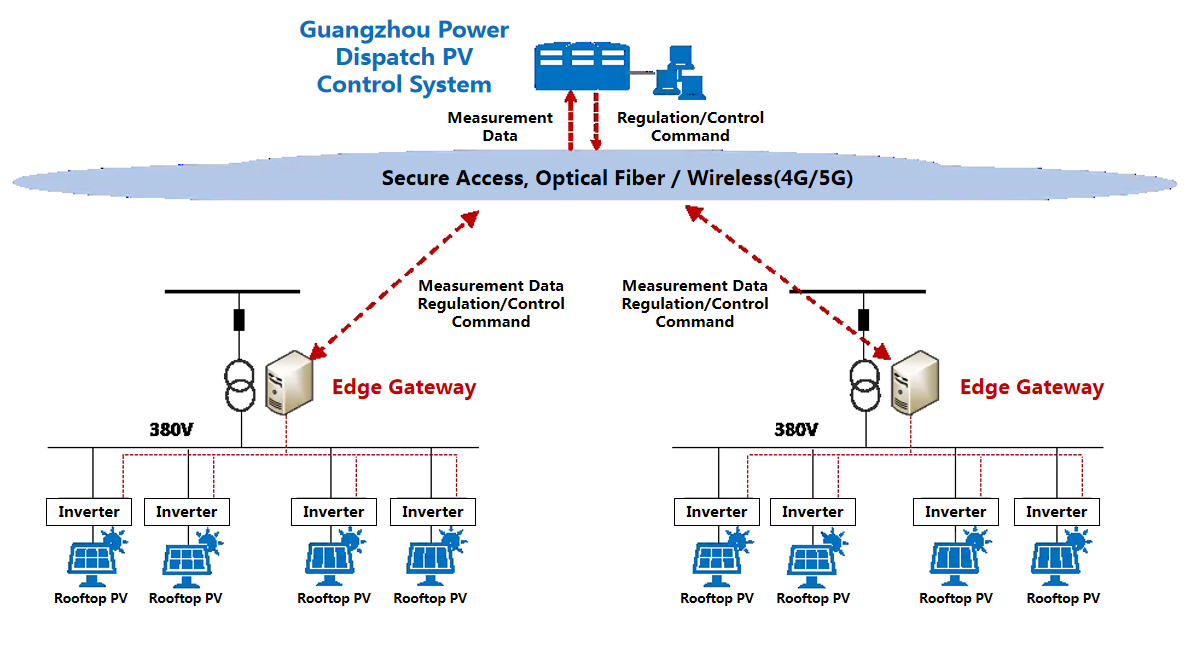
The "group dispatch and group control" technology of the dispatching system, centered on the principles of being observable, measurable, controllable, and adjustable, achieves refined PV resource management through data integration and hierarchical control, thereby ensuring grid safety and stability.
The system is built on a two-tier control framework—"day-ahead" and "intra-day":
- Day-Ahead: Output plans are formulated in advance. For special periods such as holidays, next-day control instructions are issued to relevant power stations to guide proactive responses.
- Intra-Day: Real-time responses are achieved through "group dispatch" and "group control." "Group dispatch" simultaneously issues output adjustment commands to stations with regulation capabilities. "Group control" aggregates small-scale distributed PV units into a "virtual power plant," optimizing operational statuses on demand to quickly stabilize grid fluctuations.
The coordinated "day-ahead + intra-day" approach transforms PV from a grid "variable" into a "controllable incremental resource," supporting the stable operation of grids with high shares of new energy and facilitating the grid's transition toward cleaner, more efficient, and intelligent operations.
IV. Engineering Application Results and Scalable Promotion Value
Dongfang Electronics' comprehensive solution delivers multiple engineering benefits: real-time data collection and local intelligent diagnosis convert vast amounts of dispersed PV data into measurable, quantifiable, and alertable transparent information, thoroughly resolving the "invisibility" issue; second-level regulation enables precise PV output control, addressing integration challenges; compact design and intelligent O&M reduce costs and improve efficiency; and multi-gateway collaboration aggregates dispersed PV units into a "green energy pool," transforming PV from a passive power source into a dispatchable resource.
According to plans, by the end of 2026, the controllable PV capacity equipped with Four-Controllability Gateways in Guangzhou will exceed 200 megawatts. This is expected to add over 150 million kilowatt-hours of flexible regulated green power, meeting the electricity needs of nearly 100,000 households and reducing carbon dioxide emissions by 10,000 tons—laying a foundation for nationwide promotion.
A representative from Guangzhou Power Supply Bureau stated: "Ensuring that green power is not only generated but also used stably enhances distribution network safety and unlocks the value of PV resources." Achieving this goal relies on the core technologies of the Four-Controllability Gateway and the coordinated control system. Looking ahead, Dongfang Electronics will continue to deepen its efforts in the fields of new power systems and new energy regulation, continuously optimizing product performance and expanding application scenarios, using technological innovation to support the steady realization of China's "dual carbon" goals.